

Can a PE Granulation Line produce granules of different sizes?
Sep 30, 2025
Can a PE Granulation Line produce granules of different sizes?
As a supplier of PE Granulation Lines, I often encounter questions from customers about the capabilities of our equipment, particularly regarding the production of granules of different sizes. In this blog post, I will delve into the technical aspects of a PE Granulation Line and explain how it can indeed produce granules of various sizes.
First, let's understand the basic working principle of a PE Granulation Line. A typical PE Granulation Line consists of several key components, including an extruder, a die head, a cooling system, and a pelletizing unit. The process begins with the raw PE material being fed into the extruder. Inside the extruder, the material is heated and melted under high pressure and temperature. The molten PE is then forced through the die head, which has small holes of a specific diameter. As the molten PE exits the die head, it forms continuous strands. These strands are then cooled in a water bath or by air to solidify them. Finally, the solidified strands are cut into granules by the pelletizing unit.
The size of the granules produced by a PE Granulation Line is primarily determined by two factors: the diameter of the holes in the die head and the cutting speed of the pelletizing unit.

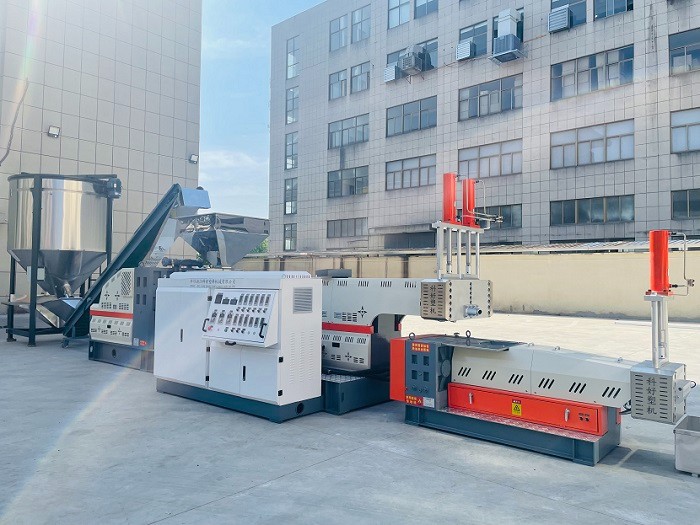
Die Head Design
The die head is a crucial component that plays a significant role in determining the size of the granules. Die heads can be designed with different hole diameters. For example, a die head with smaller holes will produce thinner strands, which, when cut, will result in smaller granules. Conversely, a die head with larger holes will produce thicker strands and larger granules.
Most modern PE Granulation Lines are equipped with interchangeable die heads. This means that operators can easily swap out the die head to change the size of the granules they want to produce. For instance, if a customer needs small-sized granules for a particular application, such as in the production of fine plastic fibers, they can install a die head with small holes. On the other hand, if larger granules are required, perhaps for use in injection molding of large plastic parts, a die head with larger holes can be used.
Cutting Speed
The cutting speed of the pelletizing unit also affects the size of the granules. The pelletizing unit typically consists of rotating blades that cut the solidified strands into granules. By adjusting the rotational speed of the blades, the length of the granules can be controlled. A higher cutting speed will result in shorter granules, while a lower cutting speed will produce longer granules.
For example, if a customer wants to produce small, uniform-sized granules, the cutting speed can be increased. This will ensure that the strands are cut into shorter lengths, resulting in smaller granules. Conversely, if larger granules are desired, the cutting speed can be decreased.
In addition to these two main factors, other variables such as the extrusion rate, the cooling rate, and the properties of the raw PE material can also have a minor impact on the final size of the granules. However, with proper control and adjustment of the die head and cutting speed, a PE Granulation Line can produce granules within a wide range of sizes.
Applications of Different Sized Granules
Different industries have different requirements for the size of PE granules. Small-sized granules are often used in applications where a high surface area to volume ratio is needed. For example, in the production of plastic films, small granules can melt more quickly and evenly, resulting in a smoother and more uniform film. They are also commonly used in the manufacturing of plastic fibers, where fine granules are essential for producing thin and high - quality fibers.
Large-sized granules, on the other hand, are suitable for applications where a higher melting time is acceptable and where the mechanical properties of the final product are more important. Injection molding of large plastic parts, such as automotive components or household appliances, often requires large granules. These granules can provide better flow properties during the molding process and can result in stronger and more durable parts.
Our Company's Solution
At our company, we offer a range of PE Granulation Lines that are designed to provide maximum flexibility in granule size production. Our lines are equipped with high - quality, interchangeable die heads that can be easily replaced to accommodate different granule size requirements. The pelletizing units are also adjustable, allowing for precise control of the cutting speed.
In addition to the standard PE Granulation Line, we also provide customized solutions for customers with specific needs. Our team of experienced engineers can work closely with customers to design and manufacture a granulation line that meets their exact requirements for granule size, production capacity, and other parameters.
If you are interested in other types of plastic granulating equipment, we also offer PP Pelletizing Machine and PVC Cable Pelletizing Machine. These machines are also designed with the latest technology to ensure high - quality and efficient production.
Contact Us for Purchase and Negotiation
If you are in the market for a PE Granulation Line or have any questions about granule size production, we encourage you to contact us. Our sales team is ready to provide you with detailed information about our products, including technical specifications, pricing, and after - sales service. We believe that our PE Granulation Lines can meet your production needs and help you achieve greater success in your business. You can visit our product page PE Granulation Line for more details.
References
- "Plastic Extrusion Technology" by Allan A. Griff. This book provides in - depth knowledge about the extrusion process, including the role of die heads and cutting units in granule production.
- "Handbook of Plastic Materials and Technology" edited by Irvin I. Rubin. It offers comprehensive information on various plastic processing methods and the factors affecting the properties of plastic granules.