

What is the working principle of a PS Pelletizing Machine?
Nov 20, 2025
Hey there! As a supplier of PS Pelletizing Machines, I'm super stoked to break down the working principle of these nifty pieces of equipment. So, let's dive right in!
The Basics of PS Pelletizing Machines
First off, what's PS? Polystyrene (PS) is a widely used plastic known for its versatility. It's used in everything from disposable cutlery to insulation materials. A PS Pelletizing Machine is designed to transform PS plastic waste or raw PS materials into uniform pellets, which can then be used to manufacture new plastic products.
The Feeding Stage
The whole process kicks off at the feeding stage. You've got a hopper at the top of the machine, and that's where you pour in the PS material. It could be PS scraps, recycled PS products, or virgin PS resin. The hopper acts like a storage area, slowly releasing the material into the next part of the machine.
The feeding mechanism is usually a screw conveyor. This screw rotates and pushes the PS material forward, into the barrel of the machine. It's important to have a consistent feed rate. If you dump too much material at once, the machine can get clogged, and if the feed is too slow, it'll affect the overall production efficiency.
The Melting and Mixing Stage
Once the PS material enters the barrel, things start to heat up – literally! The barrel is equipped with heating elements that raise the temperature of the PS to its melting point. Polystyrene typically melts at around 210 - 240 degrees Celsius.
Inside the barrel, there's another screw, called the extruder screw. This screw not only moves the PS material forward but also mixes it thoroughly. As the PS melts, any impurities or additives get evenly distributed throughout the molten plastic. This mixing is crucial to ensure that the final pellets have consistent properties.
The extruder screw has different sections with varying pitch and depth. The initial section is designed to compress the PS material, which helps in better heat transfer and melting. As the material moves further along the screw, it enters a section where the pitch decreases, increasing the pressure and ensuring a more homogeneous mixture.

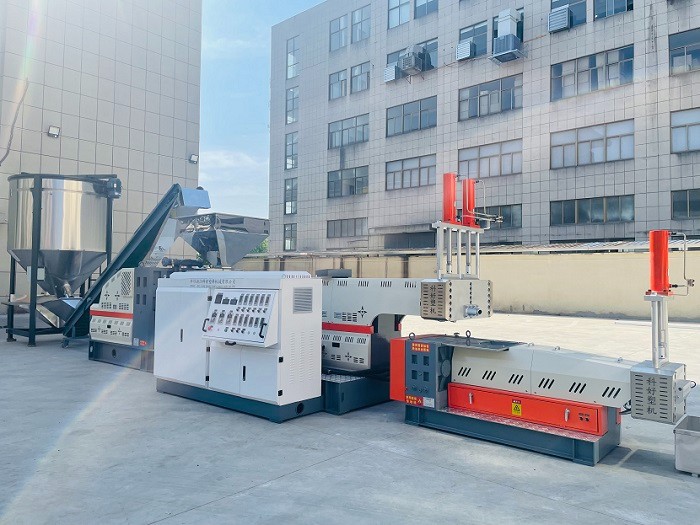
The Filtration Stage
After the PS is melted and mixed, it passes through a filtration system. This system is essential for removing any foreign particles, such as dirt, metal fragments, or undissolved impurities. The filter usually consists of a screen pack, which is a series of fine mesh screens.
The molten PS is forced through these screens under high pressure. The screens trap the impurities, allowing only the clean, pure molten plastic to pass through. Over time, the screens can get clogged with impurities, so they need to be replaced periodically. Some advanced PS Pelletizing Machines have automatic screen changers, which can replace the screens without stopping the production process.
The Pelletizing Stage
Once the molten PS has passed through the filter, it reaches the die head. The die head has a series of small holes, which give the molten plastic its shape. As the molten PS is forced through these holes, it comes out in the form of thin strands.
These strands are then cooled down rapidly. There are different cooling methods, but the most common one is water cooling. The strands are submerged in a water tank, which quickly solidifies them. Once the strands are cooled and solid, they are cut into small pellets by a pellet cutter.
The pellet cutter can be either a rotary cutter or a blade cutter. A rotary cutter has rotating blades that cut the strands at a high speed, producing uniform-sized pellets. The size of the pellets can be adjusted by changing the speed of the cutter and the speed of the strand extrusion.
The Drying and Packaging Stage
After the pellets are cut, they are still wet from the water cooling process. So, they need to be dried. A dryer is used to remove the moisture from the pellets. This can be a hot air dryer or a centrifugal dryer.
Once the pellets are dry, they are ready for packaging. The pellets are usually collected in a hopper and then transferred to bags or containers. The packaging process ensures that the pellets are protected from moisture, dust, and other contaminants during storage and transportation.
Comparison with Other Pelletizing Machines
It's worth mentioning how a PS Pelletizing Machine compares to other types of pelletizing machines, like the PP Pelletizing Machine and the PVC Cable Pelletizing Machine.
PP (Polypropylene) has different melting and processing characteristics compared to PS. A PP Pelletizing Machine needs to be adjusted to handle the specific properties of PP, such as its lower melting point and different flow behavior.
PVC Cable Pelletizing Machines are designed to process PVC materials used in cable manufacturing. These machines need to be able to handle the special additives and requirements of PVC cables, such as flame retardants and insulation properties.
Why Choose Our PS Pelletizing Machines
As a supplier, we offer top - notch PS Pelletizing Machines. Our machines are built with high - quality materials, ensuring long - term reliability and durability. They are also designed with advanced technology, which allows for easy operation and maintenance.
We understand that every customer has different needs, so we can customize our machines according to your specific requirements. Whether you need a small - scale machine for a startup or a large - scale production line for an established factory, we've got you covered.
Contact Us for Procurement
If you're in the market for a PS Pelletizing Machine, or if you have any questions about the working principle or our products, don't hesitate to reach out. We're here to help you make the right choice for your business. Whether you're looking to recycle PS waste or produce new PS pellets, our machines can meet your production goals.
References
- "Plastic Extrusion Technology Handbook" by Hanser Publishers
- "Handbook of Plastic Recycling" by Steven M. A. Belmont